
AI-Driven Cybersecurity & Zero Trust Architecture in 2026
An authoritative, enterprise-grade guide to implementing AI threat detection, Zero Trust Network Access (ZTNA), NIST CSF 2.0, and OWASP LLM security controls.

Aziz Ullah
CEO & Lead AI Architect
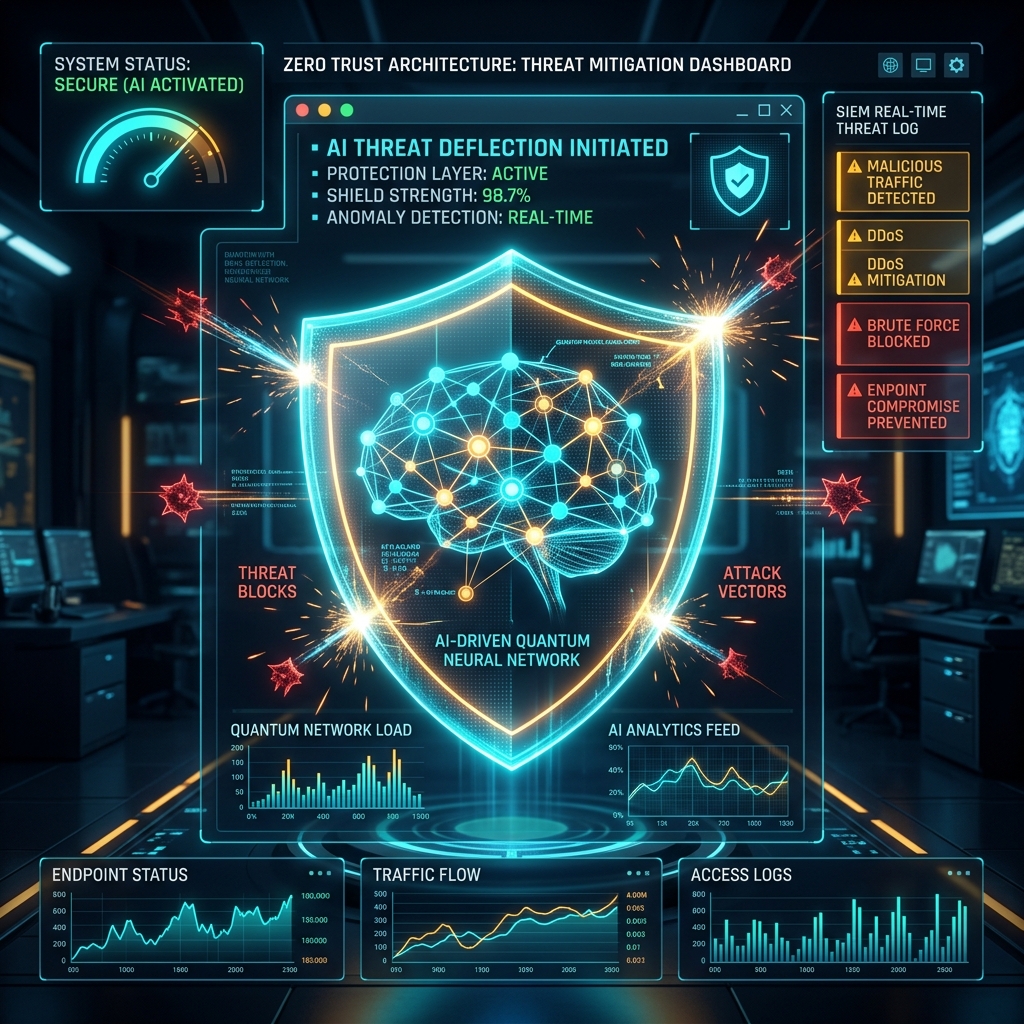
AI-Driven Cybersecurity & Zero Trust Architecture: The 2026 Enterprise Defense Blueprint
In 2026, enterprise security boundaries have completely dissolved. With cloud-native microservices, hybrid workforce models, and autonomous AI agents executing system actions across multi-cloud environments, traditional perimeter defense ("castle-and-moat") is officially obsolete.
According to IBM's 2026 Cost of a Data Breach Report, the global average cost of a data breach has reached $4.88 million, with breaches involving unmonitored AI agents and stolen identity credentials taking an average of 258 days to identify and contain.
To survive in this modern threat landscape, CISOs, CTOs, and IT directors must combine Zero Trust Architecture (ZTA) with real-time AI-Driven Automated Threat Telemetry.
This comprehensive guide breaks down how modern organizations deploy machine learning defense models, enforce Zero Trust controls under NIST CSF 2.0, mitigate OWASP LLM vulnerabilities, and build resilient incident response pipelines.
1. The 2026 Threat Landscape: Why AI Cyber Defense Is Mandatory
Modern cyber adversaries are no longer relying on simple phishing emails or uncoordinated brute-force attacks. Cybercrime syndicates now utilize adversarial generative AI to orchestrate hyper-targeted exploits:
- AI-Generated Polymorphic Malware: Malware binaries that alter their code structure in real-time to evade signature-based Antivirus and traditional EDR tools.
- Deepfake Identity Spoofing: Real-time voice and video synthesis used to bypass biometrics and deceive helpdesks into executing unauthorized password resets.
- Automated Vulnerability Scanning & Exploit Generation: Automated LLM bots that scan public IP subnets, locate zero-day vulnerabilities in open-source dependencies, and craft working exploits within minutes of disclosure.
+-------------------------------------------------------------------------+
|                  EVOLUTION OF THE ENTERPRISE THREAT VECTOR             |
+-------------------------------------------------------------------------+
| 2016: Static Malware Signatures  --> Blocked by File Hashes / Antivirus  |
| 2021: Cloud Ransomware & Creds   --> Blocked by Static MFA & Perimeters |
| 2026: AI Polymorphic Exploits    --> Defeated ONLY by AI + Zero Trust    |
+-------------------------------------------------------------------------+
2. Core Pillars of Zero Trust Architecture (ZTA)
Zero Trust operates under a single fundamental maxim: "Never Trust, Always Verify."
Every access request — whether originating from an internal developer laptop, a cloud microservice, or an external API bot — must be authenticated, authorized, and dynamically validated before granting least-privilege access.
The 5 Pillars of CISA's Zero Trust Maturity Model 2.0
- Identity: Enforce Phishing-Resistant FIDO2/WebAuthn Multi-Factor Authentication (MFA) and Continuous Identity Verification.
- Devices: Continuous telemetry evaluation of endpoint health, patch levels, and risk posture before allowing network session establishment.
- Networks: Micro-segmentation of cloud VPCs and local subnets to restrict lateral threat movement.
- Workloads: Securing containerized microservices, CI/CD deployment pipelines, and serverless functions using immutable infrastructure patterns.
- Data: End-to-end AES-256 encryption at rest, TLS 1.3 in transit, and dynamic Data Loss Prevention (DLP) policies enforced by AI inspection.
3. How AI & Machine Learning Empower Zero Trust Telemetry
Zero Trust cannot function statically. Evaluating risk scores across millions of events per second requires automated Machine Learning models.
A. User and Entity Behavior Analytics (UEBA)
UEBA algorithms establish dynamic behavioral baselines for every employee and system service account.
# Conceptual AI Anomaly Scoring Algorithm
def evaluate_access_risk(event):
    baseline_score = calculate_historical_baseline(event.user_id)
    device_trust = verify_device_compliance(event.device_id)
    geo_velocity = calculate_impossible_travel(event.ip_address, event.last_login_time)

    anomaly_score = (event.risk_factor * 0.4) + (geo_velocity * 0.4) + ((100 - device_trust) * 0.2)

    if anomaly_score > 85.0:
        trigger_soar_containment(event.user_id)
        return "ACCESS_DENIED_MFA_STEPUP_REQUIRED"
    return "ACCESS_GRANTED"
B. Machine Learning in SOAR (Security Orchestration, Automation, and Response)
When an anomaly is detected, AI-driven SOAR playbooks execute containment actions in milliseconds:
- Isolate compromised endpoint devices from the network.
- Revoke OAuth tokens and reset user session cookies across Azure AD / Okta.
- Automatically reconfigure AWS Security Group rules to block malicious C2 IP ranges.
4. Mitigating the OWASP Top 10 for LLMs & Generative AI
As enterprises deploy custom Large Language Models and AI Agents, security teams face novel threat vectors defined in the OWASP Top 10 for LLMs:
| OWASP Vulnerability | Risk Description | Real-World Defense Strategy | | :--- | :--- | :--- | | LLM01: Prompt Injection | Adversarial text forces the model to bypass safety guardrails or execute unauthorized SQL/API calls. | Implement dual-LLM input sanitization, structural JSON schemas, and deterministic Pydantic validation. | | LLM02: Sensitive Information Disclosure | LLM outputs confidential system data, API keys, or customer PII in responses. | Enforce real-time regex/NLP DLP filtering on model completion tokens before rendering to the client. | | LLM06: Excessive Agency | Granting an AI Agent unrestricted read/write permissions to internal databases or administrative tools. | Enforce strict Role-Based Access Control (RBAC) with Mandatory Human-in-the-Loop (HITL) approval for write actions. | | LLM08: Vector and Embedding Poisoning | Malicious actors upload corrupted files to RAG vector stores to manipulate model outputs. | Cryptographically sign embedding datasets and implement vector cosine-similarity anomaly detection. |
5. Step-by-Step Incident Response & Zero Trust Blueprint
+-------------------------------------------------------------------------+
|                  ZERO TRUST INCIDENT RESPONSE PIPELINE                 |
+-------------------------------------------------------------------------+
| [ STEP 1: DETECT ]  --> SIEM/EDR AI Telemetry flags anomaly (>85 risk)  |
|                                    |                                    |
| [ STEP 2: CONTAIN ] --> SOAR revokes JWT token & isolates IP in 200ms   |
|                                    |                                    |
| [ STEP 3: ANALYZE ] --> Threat Intelligence Agent correlates MITRE logs |
|                                    |                                    |
| [ STEP 4: RECOVER ] --> Immutable backup restored & patches applied     |
+-------------------------------------------------------------------------+
6. Actionable Security Recommendations for CISOs in 2026
- Conduct a Zero Trust Readiness Audit: Map all corporate digital assets across the 5 CISA Zero Trust pillars.
- Enforce Phishing-Resistant MFA: Eliminate legacy SMS and OTP authenticators in favor of FIDO2 hardware keys.
- Sanitize AI Agent Tool Pipelines: Ensure all AI microservices operate within sandbox containers with strict outbound network egress rules.
- Partner with Specialized Cybersecurity & AI Experts: Engage experienced security architects to audit code, conduct penetration testing, and design Zero Trust telemetry pipelines.
Summary & Strategic Next Steps
Implementing an AI-Driven Zero Trust Architecture is not a one-time product purchase — it is an ongoing strategic transformation. By combining NIST CSF 2.0 governance with real-time machine learning threat containment, organizations can innovate with AI while remaining resilient against modern cyber threats.
Need expert assistance securing your AI infrastructure or implementing Zero Trust controls? Contact the Cybersecurity & AI Engineering Team at Maruf Tech today for a comprehensive security consultation.
Topic Tags
References & External Citation Papers
Aziz Ullah
CEO & Lead AI Architect at Maruf Tech. Passionate about designing enterprise AI solutions, modern web apps, and machine learning infrastructure.