
Why Every Business Needs Custom Software Embedded with Generative AI in 2026
An in-depth executive guide explaining how embedding custom Generative AI models into enterprise software transforms operational efficiency, decision-making, and customer experiences.

Aziz Ullah
CEO & Lead AI Architect
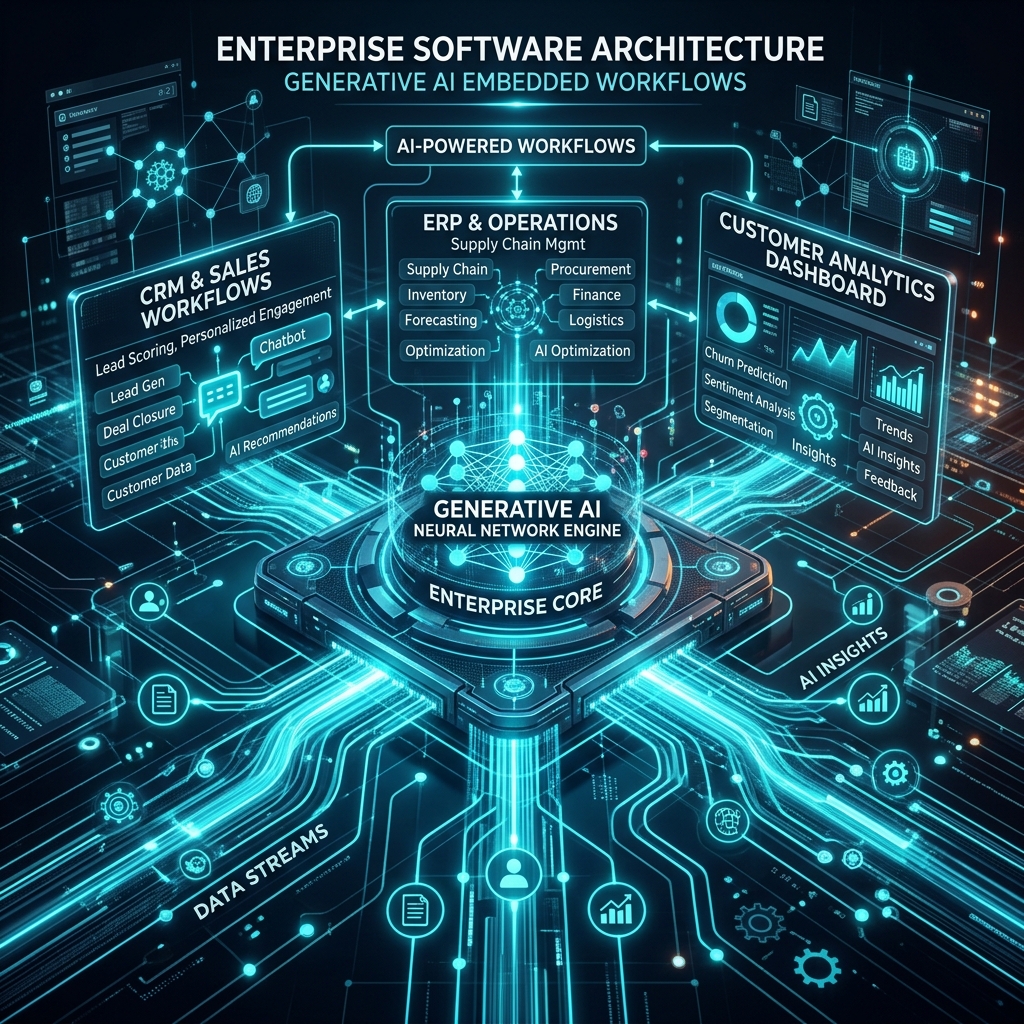
In 2026, software is no longer just a digital record-keeper or database interface. Modern enterprises are moving away from passive, click-heavy software toward Intelligent Enterprise Applications embedded directly with Generative AI (GenAI) engines.
If your company is still relying on static ERPs, traditional CRMs, or manual document-processing workflows, you are operating at a compounding speed and cost disadvantage compared to AI-native competitors.
1. The Paradigm Shift: From Passive Software to Generative Enterprise Intelligence
For decades, business software followed a rigid pattern: human users manually entered data, clicked through menus, exported CSV files, and compiled reports.
Generative AI flips this model on its head:
- Automated Data Synthesis: Instead of staff reading 50-page vendor proposals, embedded LLM pipelines summarize core risk metrics, contract liabilities, and key pricing clauses automatically in seconds.
- Natural Language Control Interfaces: Employees interact with enterprise data using plain English (or Urdu) text and voice commands — "Show me all high-churn accounts in Q1 and generate a personalized re-engagement campaign for each."
- Context-Aware Action Execution: GenAI doesn't just suggest answers; it drafts responses, populates ERP entries, and invokes specialized microservices via secure API channels.
2. Core Pillars of Embedded Generative AI in Business Software
Integrating Generative AI directly into custom web applications and core operational software provides four structural capabilities:
Pillar A: Retrieval-Augmented Generation (RAG) on Enterprise Knowledge
Generic LLMs like ChatGPT don't know your company's proprietary pricing rules, internal Slack history, or customer support archives. By implementing a RAG Architecture, your software indexes all internal documents into a secure vector database (e.g., Qdrant or Pinecone).
When an employee or customer asks a question, the software retrieves the exact relevant excerpts and synthesizes a grounded answer with verified citations — eliminating model hallucinations.
Pillar B: Dynamic Document & Content Generation
Whether generating personalized legal contracts, automated financial audits, technical proposals, or localization copy, embedded GenAI reduces creation timelines by up to 80% while enforcing strict brand guidelines.
Pillar C: Predictive Customer Intelligence & Next-Best Action
By combining historical telemetry data with generative reasoning models, modern CRMs dynamically score lead purchasing intent and automatically generate tailored sales pitches based on each buyer's unique pain points.
3. Real-World Business Impact Matrix
| Business Function | Traditional Software Process | Embedded Generative AI Workflow | Measured ROI / Efficiency Gain | | :--- | :--- | :--- | :--- | | Customer Support | Static FAQs & human agent tickets | Autonomous RAG-powered sub-agents resolving routine queries 24/7 | 75% reduction in ticket resolution time | | Legal & Procurement | Manual contract review (4-6 hours per doc) | Instant clause extraction, compliance scoring & redlining | 85% faster contract execution cycles | | Sales & CRM | Manual email drafting & lead logging | Automated prospect research & personalized email generation | 3.2x increase in qualified demo bookings | | Software Quality Assurance | Manual regression test creation | Automated synthetic test case generation & bug triage | 60% reduction in post-release defects |
4. Architectural Blueprint for Custom GenAI Integration
Building a secure, scalable enterprise software system with embedded Generative AI requires a multi-layered cloud architecture:
+-------------------------------------------------------------------------+
|                  CUSTOM GENERATIVE AI SOFTWARE BLUEPRINT                 |
+-------------------------------------------------------------------------+
| [ USER INTERFACE ]  --> Web Portal / Mobile App / Slack & Teams Bots    |
+-------------------------------------------------------------------------+
                                    |
                                    v
+-------------------------------------------------------------------------+
| [ API & SECURITY GATEWAY ] --> OAuth2, Rate Limiting, Input Sanitizer  |
+-------------------------------------------------------------------------+
                                    |
            +-----------------------+-----------------------+
            |                                               |
            v                                               v
+-----------------------+                       +-----------------------+
| [ RAG & VECTOR ENGINE]|                       | [ AGENTIC REASONING ] |
| Pinecone / Qdrant DB  |                       | LangChain / LlamaIndex|
+-----------------------+                       +-----------------------+
            |                                               |
            +-----------------------+-----------------------+
                                    |
                                    v
+-------------------------------------------------------------------------+
| [ LLM ORCHESTRATION ] --> Fine-Tuned Llama 3 / Claude 3.5 / OpenAI APIs |
+-------------------------------------------------------------------------+
                                    |
                                    v
+-------------------------------------------------------------------------+
| [ ENTERPRISE STORAGE ] --> PostgreSQL, Redis Cache, AWS S3 Secure Vault |
+-------------------------------------------------------------------------+
5. How to Get Started with Custom GenAI for Your Business
Transitioning your enterprise to AI-powered custom software does not require an immediate multi-million-dollar commitment. Follow this proven roadmap:
- Identify High-Friction Workflows: Pinpoint internal processes where highly paid employees spend hours copy-pasting, drafting emails, or reading long documents.
- Conduct a Data Health Audit: Ensure your company's knowledge repositories (PDFs, SQL tables, Notion pages) are organized and accessible.
- Build a Targeted Proof-of-Concept (PoC): Partner with a specialized AI engineering firm like Maruf Tech to develop a 4-week prototype. Measure output accuracy, latency, and end-user satisfaction before scaling to full enterprise rollout.
Summary & Strategic Next Steps
In 2026, Generative AI is no longer a luxury feature — it is the cornerstone of modern enterprise software architecture. Companies that integrate custom GenAI capabilities today will dominate operational efficiency and customer responsiveness for the next decade.
Ready to transform your business software with custom Generative AI solutions? Schedule a technical consultation with the AI engineering team at Maruf Tech to explore tailored AI integration for your company.
Topic Tags
References & External Citation Papers
Aziz Ullah
CEO & Lead AI Architect at Maruf Tech. Passionate about designing enterprise AI solutions, modern web apps, and machine learning infrastructure.